Predictability and Excitement: Soccer vs Cricket

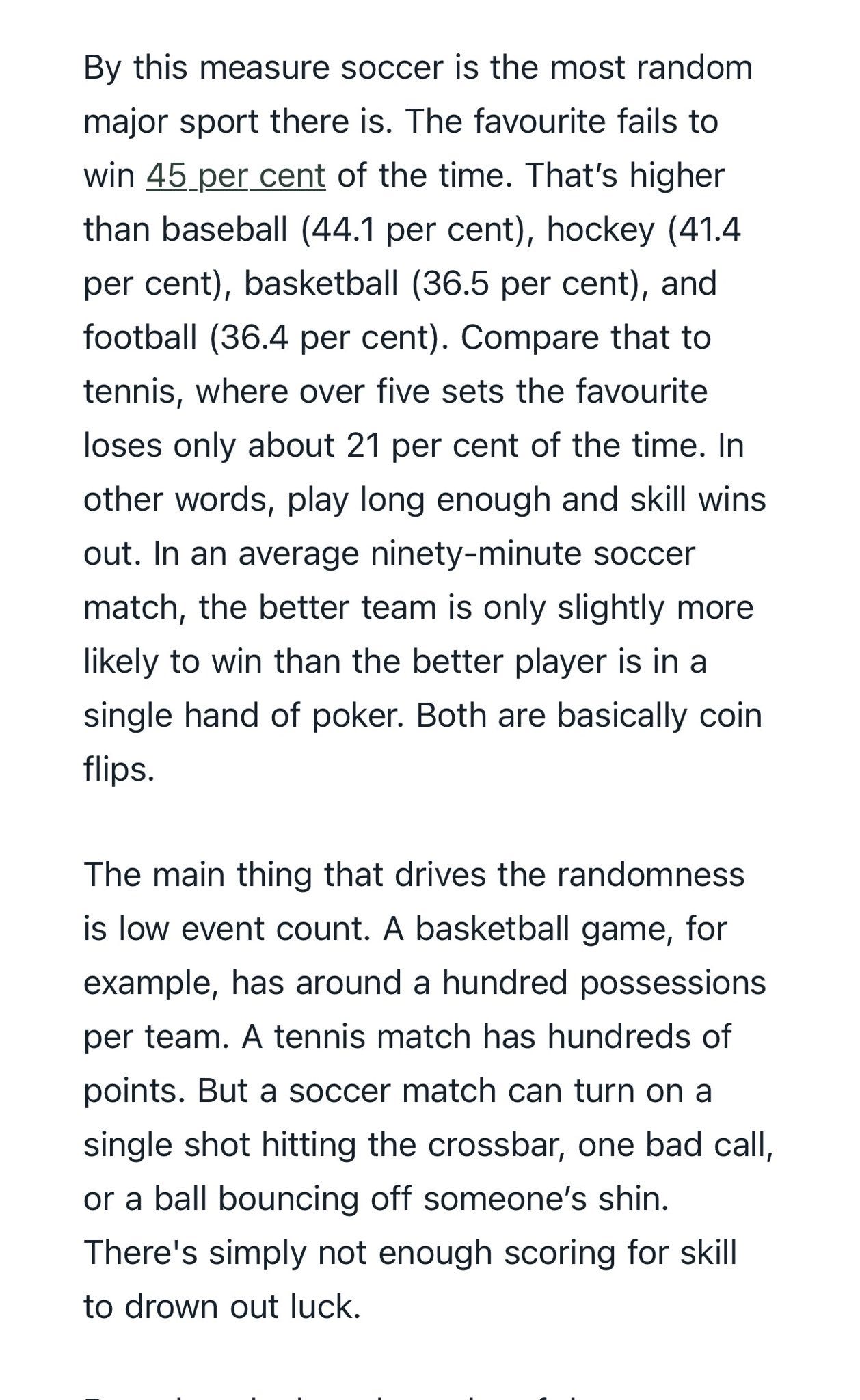
Recently, I came across an excerpt from Robert Lynch’s Why Soccer Is Boring. The author explains that the “random” nature of soccer compared to other sports makes it less watchable:
Curious about the same numbers for the different formats of cricket, I enlisted the help of data scientist Krishna Kumar, who maintains his own format-based rankings of teams, starting from 2005. Comparing the historical rankings vs match results, he found that the better team loses:
34.7% matches in Tests (with outright results);
34.5% matches in ODIs;
38.2% matches in T20Is between Full Member teams;
29.8% matches in all T20Is
Here is a graphical comparison:
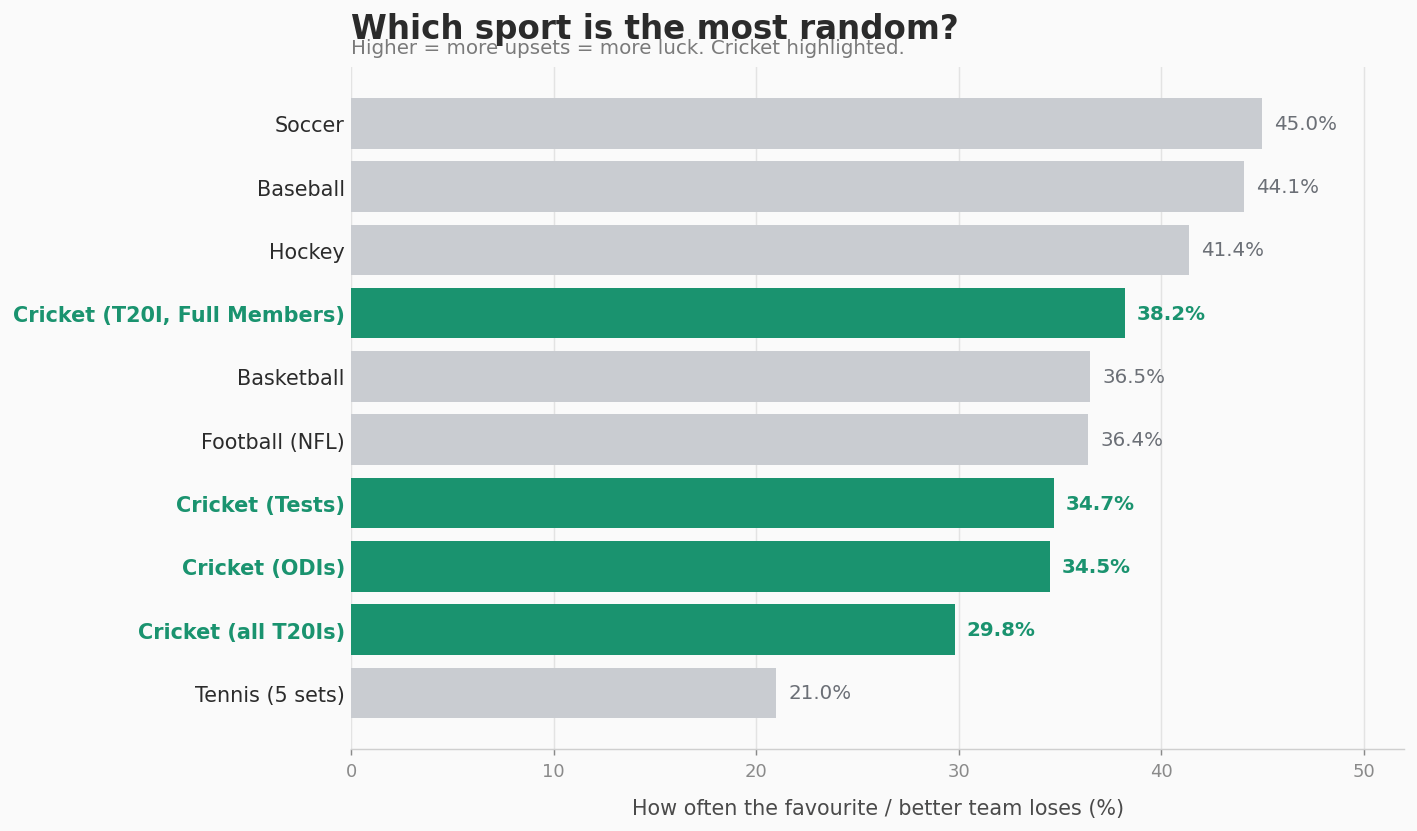
This comparison illuminates perfectly how tough it is for a new / weak team to be good at cricket. This barrier is already very high for T20Is between Full Members, but increases massively for ODIs and Tests. Both the longer formats are extremely long compared to a T20 in terms of balls — this makes it difficult for sporadic chance events to influence the outcome. You have to be consistently good for a long period to win an ODI or Test match. This is at the opposite end to soccer. It is very hard to get good at beating good teams in the longer cricket formats. Upsets are rare compared to other sports.
Contrary to Robert Lynch’s assertion, I think the “randomness” of soccer at the match level makes it very exciting and inclusive. New teams can come in and cause upsets, or witness significant periods of a winning scoreline, even against much stronger teams. The structure of the game gives a chance to a Cabo Verde to feel hope in a World Cup match. The knockout heavy nature of the FIFA WC additionally gives “weaker” teams the opportunity to progress further in the competition. In-game and in-tournament jeopardy give a real shot at glory to a wide variety of teams.
ODI cricket lies on the other end of the spectrum. Since they have to maintain quality over 600 balls, lower-ranked teams find it extremely hard to dominate or win an ODI match, as evidenced by the numbers above. Moreover, an ODI match goes on for eight hours, which is significantly longer than other sports’ runtimes. This lack of randomness makes cricket less exciting, in contrast to soccer. There is little space for new narratives, unpredictable outcomes, and new teams to emerge. Soccer is much more exciting, much more amenable to underdog victories, and much more pregnant with the possibilities of richer stories emerging from its hinterlands. Owing to this, soccer can be much more inclusive.
Of course, when new heroes do emerge, the greed and myopia of the ICC quell any chances of them going further. After Ireland did well in three ODI World Cups, a lack of fixtures against quality teams has seen them fall in quality. It is unbelievably tough to be good at cricket, any form of cricket. Emerging and promising teams need more practice and more support from cricket’s governing body to constantly better themselves. The ICC, however, is a private members’ club rather than a “governor” of any sort. Their aim is to maximise short-term earnings on the back of the Indian audience. That’s why we have one ICC event every year, including 45 different World Cups, and that’s why we will have a farcical ODI “World Cup” with 12 teams instead of 14, with convoluted chains of round-robin stages to ensure that India can play Pakistan multiple times.
That being said, I truly believe that T20s should be the vehicle for cricket’s expansion going forward. T20 is the most unpredictable format, and most likely to see upsets by weaker teams. Like soccer, this makes it the perfect format to make the game “inclusive” by giving newer teams a higher chance of winning matches at a big event. T20 is better suited for the modern age, with its 3-4 hour runtime. To be fair to them, the ICC are already going in this direction, with 20 teams in T20 WC. They should stop dangling the ODI carrot for Associate members, who have been in a gruelling 3-year qualification cycle for the ODI World Cup, just to be told they will be filtered out before the main event.
I disagree with Robert Lynch. I think the unpredictability of soccer makes it exciting and “inclusive”. And ODI cricket is the opposite for the very same reason: its predictability and the difficulty for new teams to make a mark. That is why the FIFA WC feels more like a festival. Over a short 90 minutes, David can upset Goliath and find glory. Very, very hard to see that in an ODI WC. Think of Afghanistan losing to Aus after having them on the mat at 91-7 chasing 292. They managed to beat Aus in the T20 WC a few months later.
To make it clear, I love the longer formats of cricket and I understand the derision of cricket purists at T20 for being more of a lottery. A proper Test match or an ODI played in challenging conditions with good teams has the potential for long, deep narratives and beautiful ebbs and flows. However, I think T20 will need to be the primary driver of growth and “excitement” at World Cups. I support 16 teams at the ODI World Cup; my point is just that a T20 WC will always be more inclusive, with more potential for exciting new stories and results, more so if we actually have proper jeopardy instead of the mollycoddling of the “big” teams.