
A recent article by Karthik Krishnaswamy on ESPNcricinfo debates the utility of anchors in a T20 batting order. The unfortunate choice of headline asks whether Kohli should be in your T20 team. This has led to a furore on Twitter. How can people take the bringing down of one of their heroes? How can the orchestrator of iconic knocks like that one against Australia in Mohali not be fit for an ideal T20 team?
Kohli is an all-time great conventional batsman. The merits of his methods of construction of an ODI innings are well-reflected in his 60 average. But is that the optimal strategy in T20s? Kohli spends the early phases of his innings gathering singles or defending, minimising risk to ensure he stays in the game longer. He seeks to compensate for this circumspect approach by going hammer-and-tongs in the later phases of the innings.
The detractors of this approach point to the extra pressure an anchor such as Kohli brings upon the batting order if he gets out early. He has consumed deliveries and scored slowly, but he’s not survived to make up for it. It’s a game between the frequency of crossing that barrier when he starts scoring faster, and the slowness of his early innings.
I sought to gauge just how much he falls below the ideal scoring rate early on. And whether he makes up for it to have an overall positive contribution to his side.
For this, we’ll use the Excess Runs metric.
We first build the Base Runs, the runs the “average” player would have scored in a given situation, which is defined by a) the over number, b) the wickets lost, and c) the ground. This establishes a baseline for what a par response is, given a basic definition of a “situation”, constructed from elements that affect the scoring rate.
Now, we subtract the Base Runs from the player’s score off each ball he has faced in an innings. This is the Excess Runs.
Now, obviously this definition of baseline is rudimentary - there are other factors that influence batting response. There are advanced metrics to gauge that, but none in the public domain. For now, this suffices as a basic, first-order calculation of what a “par” score is in a given situation. The Excess Runs measure tells us how much above or below par a batsman (or bowler) is.
All data from IPL 2014 onwards, from matches with results.
First, let’s look at the Powerplay overs.
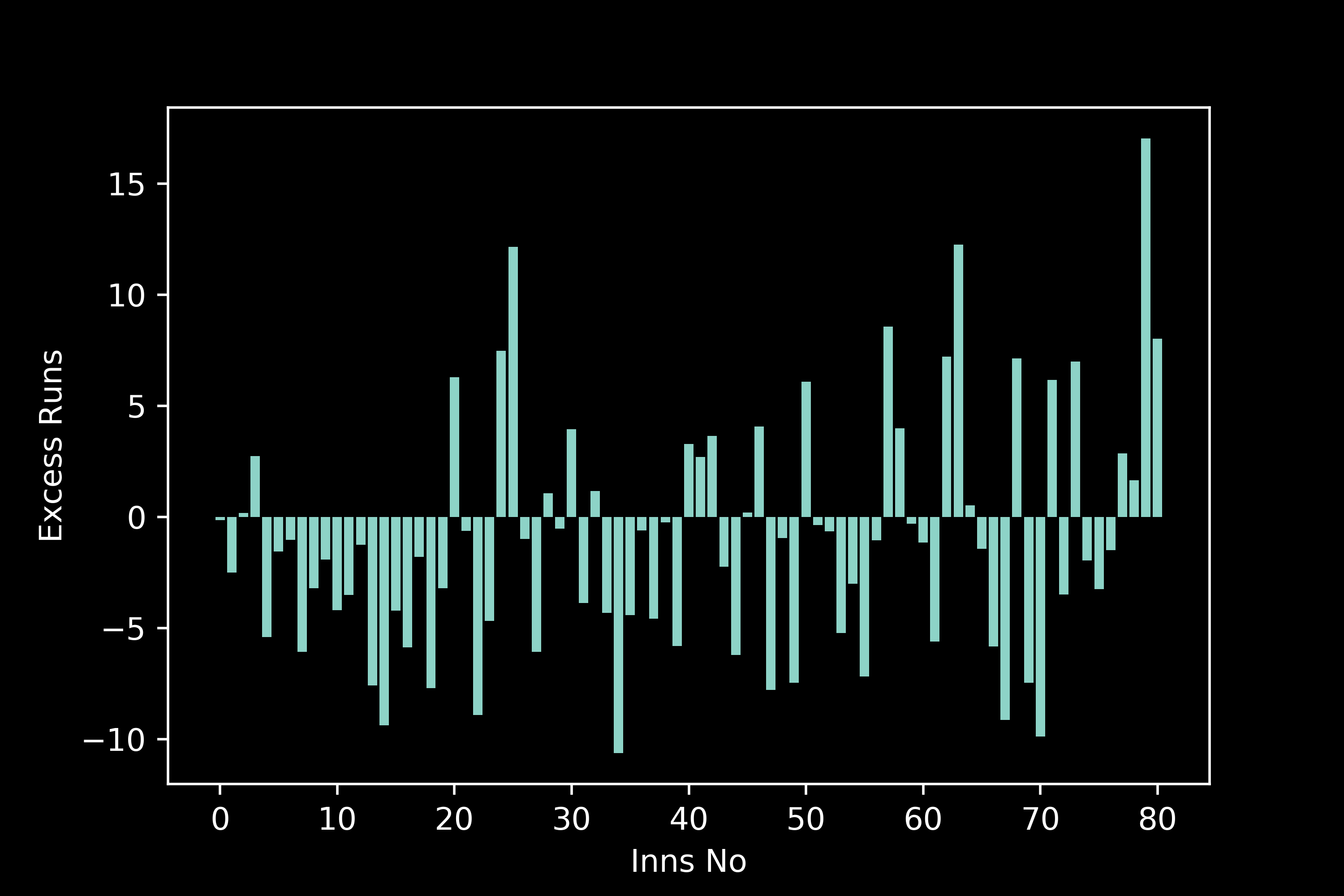
The mean contribution per match in this time is -1.02 runs. His contribution is positive in only 32% of the innings.
Here’s the mean contribution per match per season.
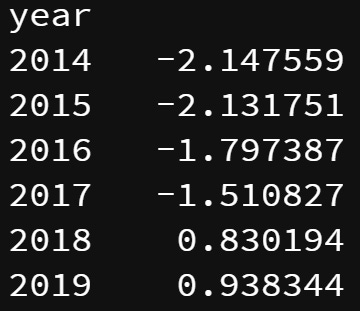
So we know that his scoring rate in the first 6 overs leads to a net run loss for the team compared to the average player, but this has improved over the last few seasons. What happens in the middle overs?
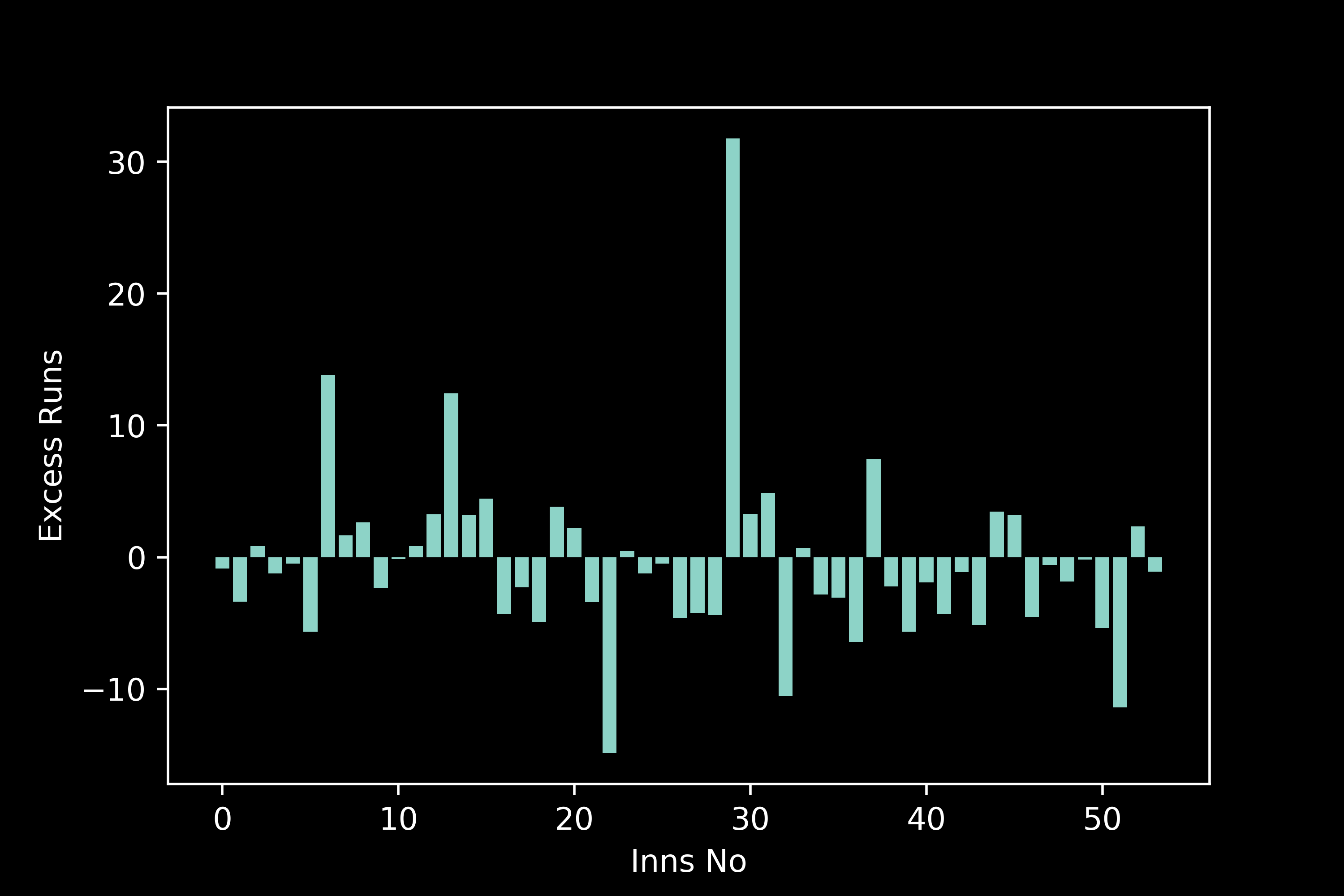
Slightly better here. The mean is -0.38, and 37% of the instances have a positive contribution. Here is the same middle overs excess runs per match mean, season-wise:
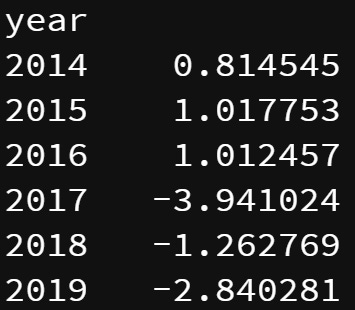
Now, whether or not Kohli compensates for this slightly below par scoring by going fast enough later on, can be checked by looking at his full-innings excess runs. If this number is positive, he’s made up for whatever he does early on by having a net positive contribution to the innings.
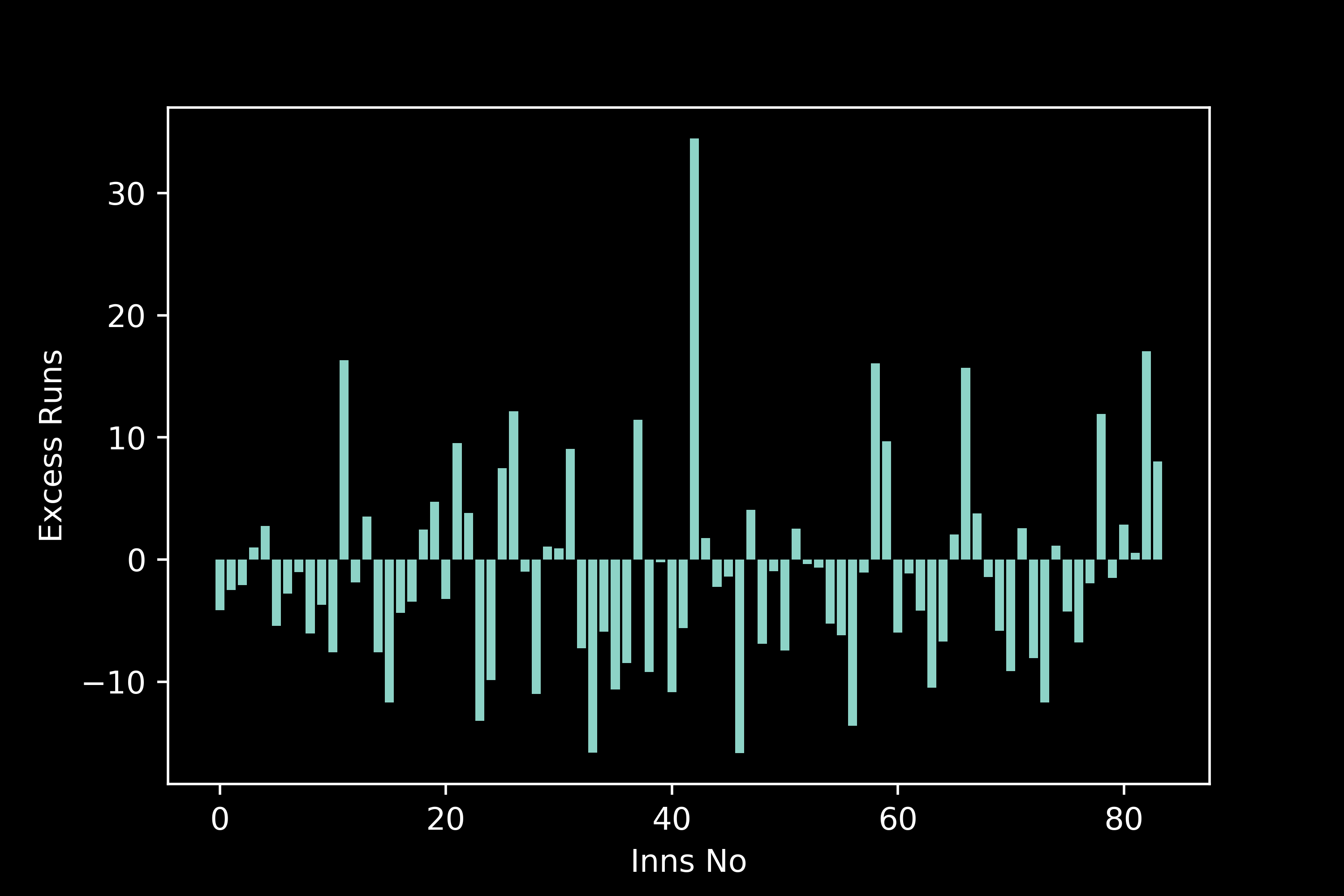
His average contribution per match is 1.16 (the median is -1.91). Here are his season-wise average contributions of Excess Runs per match:
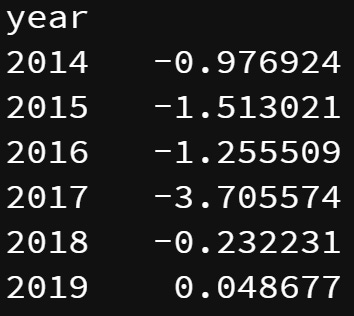
More tellingly, his contributions are positive in just 35% of his innings.
Kohli scores, on average, a net deficit of runs compared to the average player in the IPL, given the situations he bats in.
Despite having a high death overs SR, his actual contextual contribution is neither too high nor too low. In fact, his median contribution per match considering only the slog overs, is -0.8. The same figure for Pant is 1.69, and 2.56 for Russell.
So even though his aggregates and averages are high, in terms of team impact, he's at or below par. Averages don't really matter that much in T20, and T20 batting is a team endeavour.
Kohli’s death-overs striking is conditional upon surviving, which he evidently doesn’t do often enough to win this algebraic game of run contribution.
Of course, this analysis is incomplete as it considers only scoring rates, and does not factor in the highly non-linear positive effects of his ability to preserve wickets. By staying at the crease longer than others, he scores more than the player replacing him would. While this is the claim of a set of batting philosophers, it’s hard to quantify the positive effects of an “anchor”, and remains an open debate in T20 studies. Going purely by scoring rates, Kohli is slightly below par by my bare basic method.
***
The conclusion is that Kohli, albeit the best anchor going around, is ultimately suboptimal in an ideal T20 lineup. He is elite by wicket preservation metrics, but his conservative approach yields a gross negative for his side. His utility can be improved upon by replacing him with two hitters, both of whom score fast: one in the early and middle overs, and the other at the death. Both do their jobs independently, and the death hitter does not depend on the early hitter “surviving” past.
This comes from the new, maximalist school of T20 batting, that seeks to optimise the entire innings and maximise team scoring. It envisages the ideal T20 batting order as an ensemble of “hitters” that seek boundaries off every ball, and “give away” dots and singles minimally. The West Indies T20 side and many West Indian players already subscribe to this ideology: identifying six-hitting as the optimal strategy for winning a T20. You might go boom or bust living by this maxim, but you will win more games than you’ll lose. England’s white ball sides also follow this template: bat deep, bat hard.
Traditionalist notions of batting, upon which successful red ball and 50-over innings are built, are birthed from first-class cricket, where wicket preservation is axiomatic before all else. The prototype T20 hitter unshackles themselves from these ideas, and aims to score off every ball, often at high risk.
You can’t have 8 Russells and Pants in a side, you say? As T20 becomes the dominant form of the global game, and franchises and leagues settle and mature, they will invest more heavily in specialised talent, you might well see a bespoke T20 batting order, an array of fear-free hitters making 25(10) the new normal. In this brave new world, the Kohlis, Babars and Kanes will be less-than-maximally efficient, and as T20 transitions from “cricket” to a game of hitting versus stopping runs, they will likely become obsolete.
Excellent analysis. I guess the spotlight is on VK because:-
- He is currently the best all format batsman in the world today with an amazing batting averages across all formats.
- RCB's dismal IPL performances.
- The lack of ICC WT20 silverware in team India's trophy cabinet since 2007.
- Finally average is an obsolete metric for T20, and increasingly overall strike rate could be as well.
I suspect if you compare VK to other such anchors he will be ahead. I think the real question is do anchors like VK need to ( if already not ) train differently to go ballistic in the first 20 balls within the first 10 overs- especially on flat belters. Alternatively, anchors could be utilized to set up par scores by coming down the order if the designated power hitter(s) have failed at the top.
To those interested I would highly recommend reading "Cricket 2.0" to understand how and why T20 is different from ODIs. Power hitting is indeed the future of the game.
For example notice the 2016 ICC WT20 Semi India vs West Indies- here VK actually played incredibly well. But again he scored 50 off 33 ( SR 151) then next 39 runs came of 15 balls ( 200+ strike rate). I am absolutely nit picking but he could have taken bigger risks in his first 30 balls especially with Rahane struggling at the other end. Rahane's was a joke of an innings 40 ( 35) with just 2 fours tells you that he scored 32 off 33 in 1/2/3s. Basically ate up 29% of the balls to score only 20% of team runs with the team's REAL power hitters NOT even getting to bat. A clear case of anchoring gone horribly wrong. I know this was an extreme example :-) but would love to understand anchoring in T20 if it exists. Can it afford to?
Why is Kohli considered an anchor but players like Rohit and Dhawan are not? Kohli is quite clearly the best Indian batsman ever in t20 so far and has many proven international performances. Pant has terrible stats in international and Kohli actually has a higher t20 SR than most other Indian batsman despite being an anchor.